Training records and required courses
Compliance training tracker: who has done the required courses
Set a rule once, such as everyone completes fire safety within 30 days of starting and again every year. LeaveCalc works out who is done, due soon, overdue or missing, keeps the certificate with each record, and reminds people before a course lapses.
Free for up to 3 people, with a 14-day Pro trial. No card. Training records are in every plan.
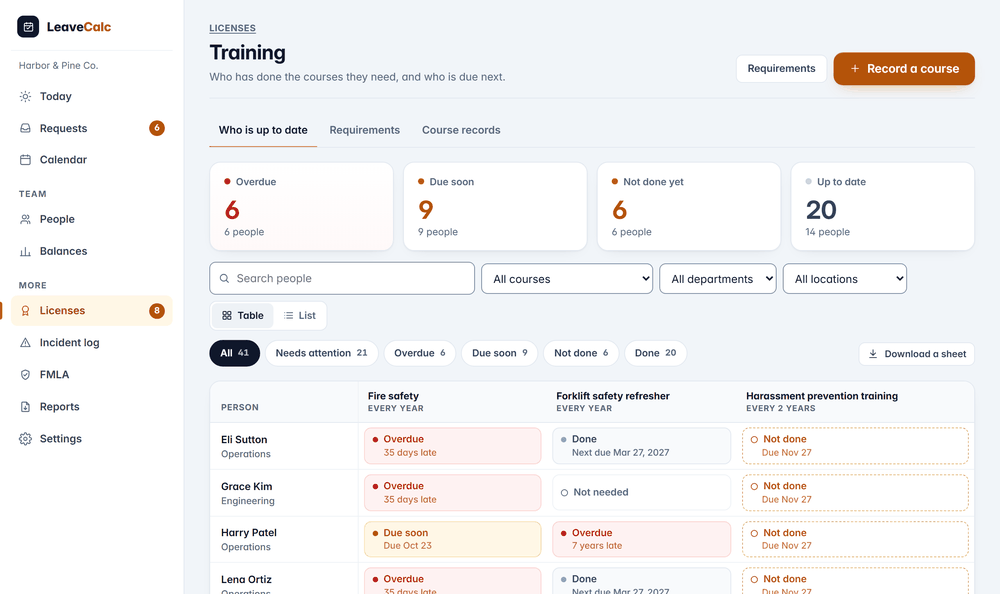
Training records are the paperwork nobody cares about until an inspector, an insurer or a lawyer asks for it. Then you have to show that this person took this course on this date and that it has not lapsed. A folder of certificates cannot do that. A spreadsheet can, if somebody keeps it up, and that somebody changed jobs in March.
LeaveCalc keeps a rule for each course, a record for each completion, and one grid that answers the question at a glance, so the owner who gets the call from an insurer, or the manager who is asked on a Friday afternoon whether everyone in the kitchen has the card, can open one screen and answer. For each person and each required course: are we fine?
Requirements
Write the rule in one sentence
A requirement reads like a sentence. Everyone in Operations must complete the forklift safety refresher within 14 days of starting and again every year. Choose who it covers: everyone, some departments, some locations, people who manage other people, or named people.
Add a deadline for new hires, a fixed date for people who are already here, a repeat time in months, or all three. Somebody who started years ago is not overdue the minute you save the rule, because the later of the two dates applies.
- When two rules cover the same person and course, the earliest deadline and the shortest repeat time win.
- Rules are an owner's setting. A manager can assign a course to named people in their own department.

Ready-made rules
Rules that say where the numbers come from
Each ready-made rule starts with the numbers its source sets, shows the page it was read from, and lets you change them. Where a rule leaves a number open, such as how often HIPAA training repeats, the rule says so and does not pretend a number is law.
| Rule | What the source says | Source |
|---|---|---|
| OSHA bloodborne pathogens | Train each employee with occupational exposure when first assigned, and at least once a year after that. Keep training records for 3 years. | 29 CFR 1910.1030(g)(2) and (h)(2) |
| HIPAA privacy | Train the whole workforce, each new person within a reasonable time. Document it and keep the record for 6 years. The rule sets no yearly repeat. | 45 CFR 164.530(b) and (j) |
| Fire safety | Review the emergency action plan with each employee at first assignment and when it changes. Where staff may use extinguishers, train at hire and every year. | 29 CFR 1910.38(f) and 1910.157(g) |
| Harassment prevention, California | 1 hour for employees and 2 for supervisors, every 2 years, within 6 months of hire or promotion. Check that your business is covered. | 2 CCR 11024(b) |
| Harassment prevention, New York | Interactive training for all employees, every year. | NY Labor Law 201-g |
| Harassment prevention, Connecticut | Employers with 3 or more employees: 2 hours within 6 months of hire, then supplemental training at least every 10 years. | Conn. Gen. Stat. 46a-54(15)(C) |
| Food handler card | Differs by state and county. LeaveCalc fills in no numbers. Ask your local health department. | None. Check locally |
Every source was read on October 13, 2026. These are plain summaries and not legal advice. Rules change and differ by state, so check yours.
Records
Record a course for one person or many
Pick the course, tick the people, and enter the date. Add the hours, the provider and a certificate number if you have them, then say how long it lasts: a number of months, or it does not expire. One record can cover up to 100 people, for a toolbox talk or a class that met in the break room.
Retaking a course adds a new record. The new one is current and the old one stays as history.
- The certificate is a PDF, JPG, PNG or HEIC file of up to 10 MB, stored encrypted with the record.
- Only an owner, or a manager for people in their own department, can download a certificate. Viewers cannot.

Statuses
What done, due soon and overdue mean
The status of a person and a course is worked out from today's date in your company's time zone. Nobody has to update it.
| Status | What it means |
|---|---|
| Done | There is a current record and it is not due within the reminder window, which is 60 days by default. A record that does not expire and has no repeat rule stays done. |
| Due soon | A current record that is due within the window, or no record and a deadline within 14 days. |
| Overdue | A current record past its due date, or no record and a deadline that has passed. |
| Not done yet | No record, and no deadline in the next 14 days. Either there is no deadline, or it is still far off. |
People are counted from their start date. A person whose start date is still in the future is left out, and so are archived people and archived courses.
What it does
The parts that make the grid trustworthy
A grid that is wrong once stops being read. These rules keep it right without anyone updating it.
Reminders that arrive early
For a course made here, the person gets an email 60 days and 14 days before the due date and another when it is overdue. Owners and managers get one grouped email a day.
On Today and in the digest
A Training card on Today counts overdue, due soon and not done yet, and the digest email names the most urgent people.
Departments are respected
A manager limited to one department sees and records only that department.
Proof next to the date
The certificate is stored with the record, so the date and the evidence are in the same place.
Download the grid
One row for each person and course, with the status, dates, hours, provider and whether a certificate is attached.
Licenses and training together
A course is also a record on the Licenses screen. When a course has a rule, the rule sends the reminders, so nobody gets two emails about it.
Compare your options
A spreadsheet or LeaveCalc
A spreadsheet works for a team of five and one course. It breaks down with three courses and different rules for different departments.
| What you need | Spreadsheet | LeaveCalc |
|---|---|---|
| Who has to take it | A column you keep up | A rule: everyone, a department, a location, supervisors or named people |
| Is it still valid | Check each date by eye | Worked out from the completed date and the repeat time |
| Reminders | Calendar entries you set yourself | 60 and 14 days before, then when it is overdue |
| Proof | Certificates in a shared folder | The file sits on the record, encrypted |
| New hires | Add a row and a due date | The deadline counts from the start date |
| A retake | Overwrite the old date | A new record, with the old one kept as history |
What the tracker does not do
- It tracks training. It does not deliver it. There are no courses, videos or quizzes inside LeaveCalc.
- The ready-made rules are plain summaries of the sources they cite, not legal advice. Only three states have a harassment training rule filled in. Every other state says check your state.
- The employee has no sign-in page for training yet. Their reminder email has no button. It names the person to tell when the course is done.
- A certificate is stored, never read. LeaveCalc does not check that it is genuine.
Pricing
Flat price by team size
One monthly price for the whole team, not a price per person. Prices are in US dollars. The employers page has the full plan details.
Free
$0per month
For teams up to 3 people
Training records included
Pro
$15per month
For teams of 4 to 25 people
Training records included
Business
$69per month
For teams of 26 to 100 people
Training records included
Enterprise
$149per month
For teams of more than 100 people, no seat limit
Training records included
Certificates share the document space of the company, 50 MB on the Free plan and 1 GB on a paid plan.
No card for Free or the 14-day trial. Cancel any time, with a 30-day money-back guarantee on paid plans. Paying yearly costs ten months for twelve.
Start freeFAQ
Questions, answered plainly
It is a record of which courses each person must take, which ones they have taken, and when each one runs out. LeaveCalc adds the part a spreadsheet forgets: a rule for each course, a status worked out fresh every day, the certificate stored with the record, and reminders before a course lapses.
That depends on the industry and the state. Common ones are OSHA bloodborne pathogens training for staff who may meet blood, HIPAA privacy training for health care workers, fire safety and emergency plans, and harassment prevention in the states that require it. LeaveCalc has a ready-made rule for each, with the source it was read from. Check your own state and industry before you rely on one.
Done means a current record that is not due within the reminder window, 60 days by default. Due soon means a record due within the window, or no record and a deadline within 14 days. Overdue means a record past its due date, or no record and a deadline that has gone by. Not done yet means no record and no near deadline. The status is worked out from today's date and never stored.
A rule can say every so many months. The due date of a record is the earlier of its own expiry date and the completed date plus the repeat time. Retaking a course adds a new record, the new one is current, and the old one stays as history. When two rules cover the same person and course, the earliest deadline and the shortest repeat time apply.
Yes. Attach a PDF, JPG, PNG or HEIC file of up to 10 MB to the record. It goes into the same encrypted document store as other files. An owner, or a manager for people in their own department, can download it. A viewer cannot.
For a course made in LeaveCalc, the person gets an email 60 days and 14 days before the due date, and when it is overdue, if they have an email address and you have not switched off emails to employees. Owners and managers get one grouped email a day. A manager limited to a department hears about that department only.
It depends on the course. Under the OSHA bloodborne pathogens standard, training records are kept for 3 years from the training date (29 CFR 1910.1030(h)(2)). HIPAA says to keep documentation for 6 years (45 CFR 164.530(j)). Other rules differ, so ask your lawyer or your state agency.
No. It tracks it. There are no courses, videos or quizzes inside LeaveCalc. People take the course wherever you send them, and you record the date, the hours and the certificate when they finish.
Also see
Know who is behind on training before an inspector does
Add a rule for one course, record who has done it, and read the grid.